


If you walk up to my front door today, you’ll see a small sign hanging right by the gate that says “Home Sweet Home.”
It’s pretty common, right? You probably have the exact same wording on your doormat, somewhere in your living room, or framed near your entrance.

As someone in my late 30s with a young family, those three words hit differently now. They aren’t just a trendy decoration I bought at a mall. They represent a real sense of hope—a quiet promise that the comfort, warmth, and financial security my wife and I are working so hard to build today will actually be passed down intact to our kids.
But after consulting on well over a hundred estate planning cases, I’ve seen a painful pattern repeat itself over and over again. For so many Malaysian families, that “sweet” home turns completely sour the moment the parents pass away.
Living rooms where brothers and sisters used to share meals turn into silent battlegrounds. Siblings stop talking to each other over a piece of property in Subang or PJ. The sad part? Almost every single one of these family heartbreaks could have been avoided if the parents had fixed their estate planning mindset while they were still alive and healthy.
Here are 4 Critical Estate Planning Mindsets Malaysian Families Should Change Today.
1. “Equal Distribution” Is Not Always “Fair”
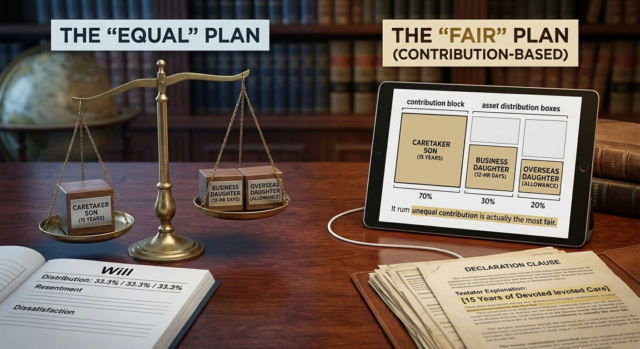
Ask almost any parent how they want to divide their assets, and 90% of them will give you the same answer: “Just split everything equally among my kids.” It sounds very reasonable, but in the real world, strict splits can actually trigger massive resentment. Why? Because absolute equality might ignores the unequal contributions each child makes in real life.
Facts / Case Sample:
For example in a household, one child might put their career on hold, move back home to care for aging parents, wake up at 3:00 AM to handle medical emergencies, and drive their parents to the hospital every month. Another child might step into the family business, working 12-hour days for a decade to keep it profitable. A third child might have moved overseas years ago, sending a small allowance home but rarely visiting.
Potential Issues / Risks:
Given these scenarios, when children have made vastly different contributions, a strict equal split easily breeds dissatisfaction among them.
Suggestion:
When everyone have different contribution towards the household, a wise parent can distribute their assts portion according to their children’s contribution.
For example, I once had a client—a fairly successful businessman. In his Will, he explicitly left 70% of his estate to his son and split the remaining 30% equally between his two daughters. On the surface, this is unfairness. However, if you knew the full picture, that son had sacrificed his own personal career pursuits, spending 15 years helping his father build the business and managing his daily care. When you factor in the physical and emotional devotion this child provided, that “unequal” distribution was actually the most fair and reasonable decision the father could have made.
In short, equal distribution is not the absolute answer to all situations. The distribution needs to be designed in a way that matches the children’s contributions in real life. Even if the distribution does not match the contribution by the children, the Testator may leave an explanation under the Declaration Clause to avoid any misunderstanding in the future.

2. The Traditional Mindset Trap “Leaving Everything to the Son”
Traditional patriarchal mindsets still run deep in many Asian households. Even today, it is not surprising to meet parents who insist on passing all their major properties and cash down exclusively to male heirs.
Potential Issues / Risks:
How you choose to distribute your own assets is entirely your freedom. However, when parents combine this traditional view with a operational mistake, things become dangerous and deeply unfair. For example, appointing the disinherited daughter as the Executor of the Will
Facts / Case Sample:
This is a real case I have witnessed: the son received 100% of the estate, while the daughter, who received zero Ringgit, was appointed as the sole Executor. Consider what is required of an Executor. Executor has to take leave from work, hire lawyers, gather bank records, pay upfront court filing fees, and deal with government offices. Meanwhile, the beneficiary (the younger brother) just sits back, does absolutely nothing, and waits to collect the entire payout.
Potential Issues / Risks:
When the person doing all the heavy lifting gets no benefit, the parents aren’t leaving behind a legacy, they are leaving behind a guaranteed family feud.
Suggestion:
The solution is that the testator should provide reasonable compensation to the executor, rather than expecting them to work without remuneration. If circumstances allow, appointing a beneficiary as the executor prevents any scenario of ‘working for free’ or ‘getting paid for doing nothing.
3. The Myth That “The Law Will Take Care of My Estate Automatically”
A lot of people skip writing a Will altogether because they blindly believe the government has built-in laws to transfer everything over to their children automatically. Yes, Malaysia has the Distribution Act 1958. However, that law is a rigid, mechanical formula. It does not understand your family dynamics, does not care who contributed what, and certainly does not care about your personal wishes. Leaving your assets to default statutory processes is essentially leaving a giant mess for your children to untangle on their own.
Facts / Case Sample:
Let me share a heartbreaking real-life case with you: A mother passed away, leaving a house registered under joint names with her younger daughter. For over a decade, the younger daughter lived in the home, cared for her mother’s daily needs, and paid off every single monthly mortgage instalments out of her own salary.
Potential Issues / Risks:
Because the mother died intestate (without a Will), her 50% share in the property fell directly under default statutory distribution rules. As a result, the elder sister—who had not contributed a single cent over the years and rarely showed up—stepped forward to legally demand her entitled share of that 50%. The younger daughter was instantly pushed into a corner: either fork out a huge sum of money to “buy back” the elder sister’s share (paying again for a house she had already fully paid off), or watch this home filled with memories be forcibly sold off.
Suggestion:
This is an issue which can be avoid by writing a Will during the testator’s life time and clearly stating the portion to be distributed.
4. Overlooking the Various Bills That Must Be Paid Before Anyone Inherits a Cent
We tend to treat estate planning like handing over a gift wrapped in a nice bow. But people forget that before your children can withdraw a single cent from your frozen bank accounts, someone has to pay out-of-pocket to settle a long list of urgent expenses. While these amounts can generally be reimbursed from the estate later, the immediate cash burden often falls on family members during an already difficult time.
Potential Issues / Risks:
Death is expensive, and the bills start accumulating long before a Grant of Probate is issued:
- Pre-death hospital bills: Medical treatment costs right before a person passes away can easily run into tens of thousands of Ringgit.
- Immediate funeral expenses: Funeral parlors and directors do not wait for probate; they require immediate cash payments.
- Legal and court fees: Lawyers need upfront retainers before they can begin filing your estate application in court.
- Outstanding debts: Housing loans, car loans, credit cards, personal loans, and even Buy Now Pay Later (BNPL) instalments do not disappear upon death.
- Asset maintenance: Condo management fees, quit rent, assessment taxes, and car maintenance still accumulate every month while the estate is frozen.
Suggestion:
The best way to solve it is to set aside a specific fund or liquid cash to clear these hurdles immediately. For example, the EPF fund and life insurance payout. This will safe your family from being forced to drain their own hard-earned personal savings just to keep your estate afloat.

Conclusion:
We live in an age that demands instant efficiency. We get food delivered in 20 minutes, get answers from AI in three seconds, and expect every problem to be fixed with a quick click.
However, proper estate planning cannot be rushed. It takes time, sincere conversations, and thoughtful structuring to get it right. It might take a few weeks or even a couple of months to lay it all out properly, but taking that first step is the only way to ensure your family is protected.
Taking the time to plan your estate properly. That’s how you actually keep your family remain sweet long after you’re gone.